Benchmarking DeepDiff Against BinDiff on Stripped and Cross-Compiler Binaries
Benchmarking DeepDiff Against BinDiff on Stripped and Cross-Compiler Binaries
DeepDiff matches related functions across binaries. This matching layer can support patch verification, version analysis, firmware comparison, malware research, and other work that requires code alignment.
In our earlier DeepDiff post, we introduced the product through a firmware patch-verification example. This post focuses on a narrower question: how accurately can DeepDiff match functions when two binaries no longer look alike?
All of these tasks start with the same question:
Which function in one binary matches a function in the other binary?
This sounds simple when both binaries come from the same build system. In that case, addresses may move, but much of the code keeps the same shape.
The problem becomes much harder when the compiler changes, symbols are removed, libraries are linked into the program, or code moves from one function to another. The two functions may come from the same source and still look very different at the binary level.
To answer that question, we compared DeepDiff with Google BinDiff across 21 binary pairs. The tests cover three common problems in binary matching:
- Different compilers can create very different control-flow graphs.
- A diffing tool cannot match functions that its disassembler never found.
- A version update can move code to a function with a different name.
This is a benchmark of DeepDiff's core matching layer. It is not a test of one specific workflow built on top of those matches.
What We Tested
We tested 21 binary pairs:
- 6 Lua pairs built with GCC or Clang at O2 or O3
- 15 minigzip pairs built with different zlib versions
Both tools received stripped binaries. To check their results, we used matching unstripped binaries with symbols.
We counted a match as correct when both addresses had the same symbol name. For example, if a tool produced this match:
0xf610 -> 0xee50
and both addresses had the symbol name luaD_call, we counted it as correct.
Some tool output used rebased addresses, so we converted those addresses back
to ELF virtual addresses before checking them.
We used two standard measures:
- Precision: Of all matches returned by the tool, how many were correct?
- Recall: Of all expected function matches, how many did the tool find?
Across all 21 pairs, the combined results were:
DeepDiff found more correct matches and made fewer wrong matches in these tests. The reason was not one single feature. Each test exposed a different part of the matching problem.
Finding 1: The Same Source Can Produce a Different Graph
BinDiff uses structural signals such as function graphs, basic-block graphs, call graphs, and edge patterns. These signals work well when the two binaries have similar structures.
That condition often holds when both binaries use the same compiler. In our Lua test, BinDiff reached about 0.95 precision and recall when both sides were built with Clang.
The result changed when one side used GCC and the other used Clang. The table below shows the average result in both directions for each pair:
Across the GCC-to-Clang pairs, BinDiff fell to about 0.59. DeepDiff stayed between about 0.84 and 0.89.
One pair makes the difference clear. The lua-clang-O2 -> lua-O2 ground truth
contained 659 functions:
For this pair, DeepDiff found 172 more correct matches and made 163 fewer wrong matches.
When Graph Size Changes
The Lua function luaH_getn shows how large the compiler difference can be:
Both versions came from the same source function. The Clang version had more than twice as many instructions as the GCC version.
BinDiff gave the correct luaH_getn -> luaH_getn match a similarity score of
only 0.104. It matched Clang's luaH_getn to GCC's close_func instead.
DeepDiff found the correct match:
0x1d9e0 -> 0x1b280, similarity 0.826
When Graph Size Looks Similar
Large graph changes are not the only problem. The two versions of luaD_call
were close in size:
- Clang: 8 basic blocks and 42 instructions
- GCC: 7 basic blocks and 40 instructions
BinDiff still matched luaD_call to dothecall. DeepDiff matched it correctly:
0xf610 -> 0xee50, similarity 0.937
The image below shows BinDiff's match. In the stripped binary, sub_F610 is
luaD_call and sub_10D80 is dothecall.
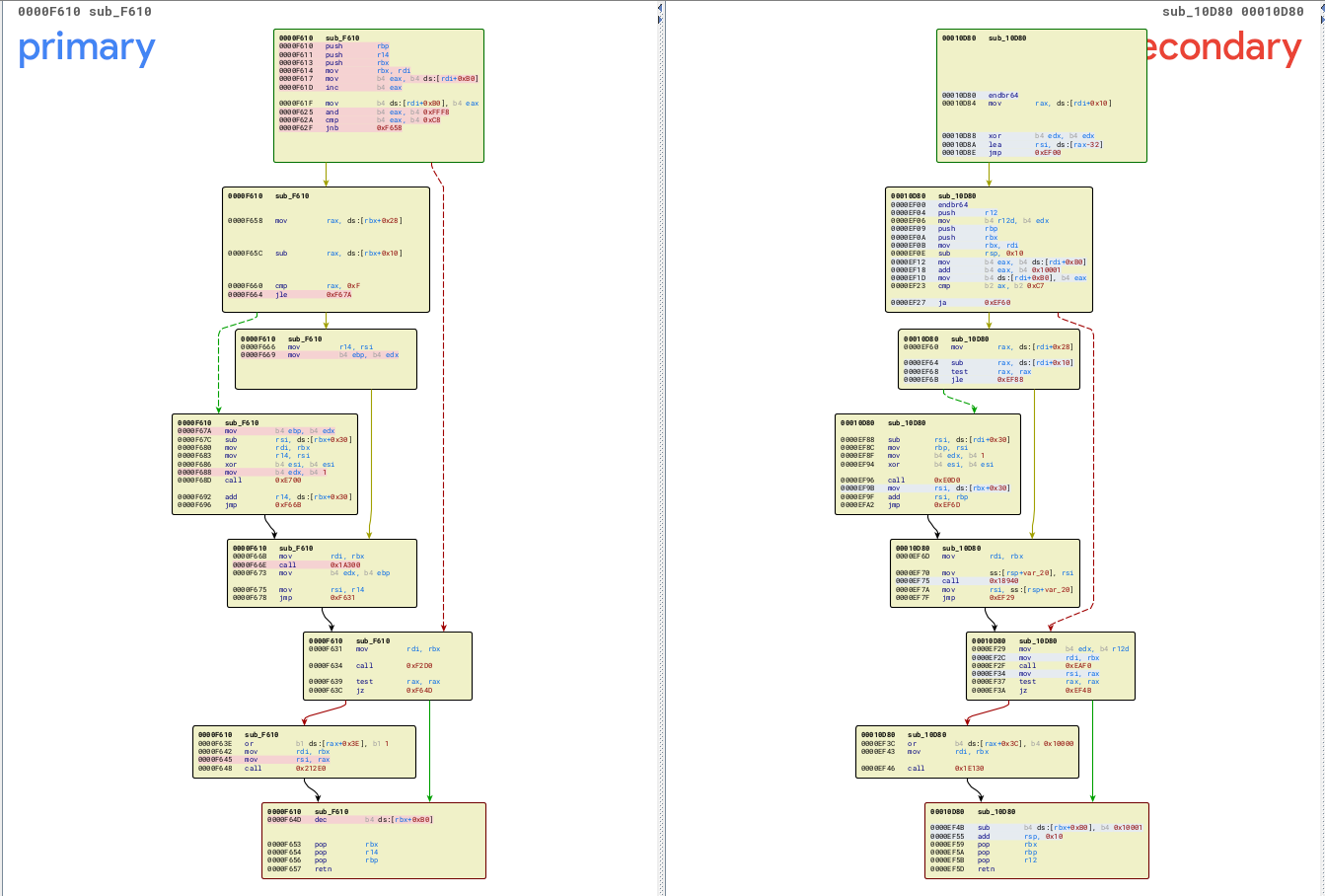
This is an important failure case. Many small functions have similar graph shapes. When the compiler changes code layout, graph structure can point to the wrong nearby function even when the number of blocks and instructions looks close.
More Examples from Lua
On this one Lua pair, DeepDiff correctly matched 220 functions that BinDiff matched incorrectly or did not match.
Here are several examples:
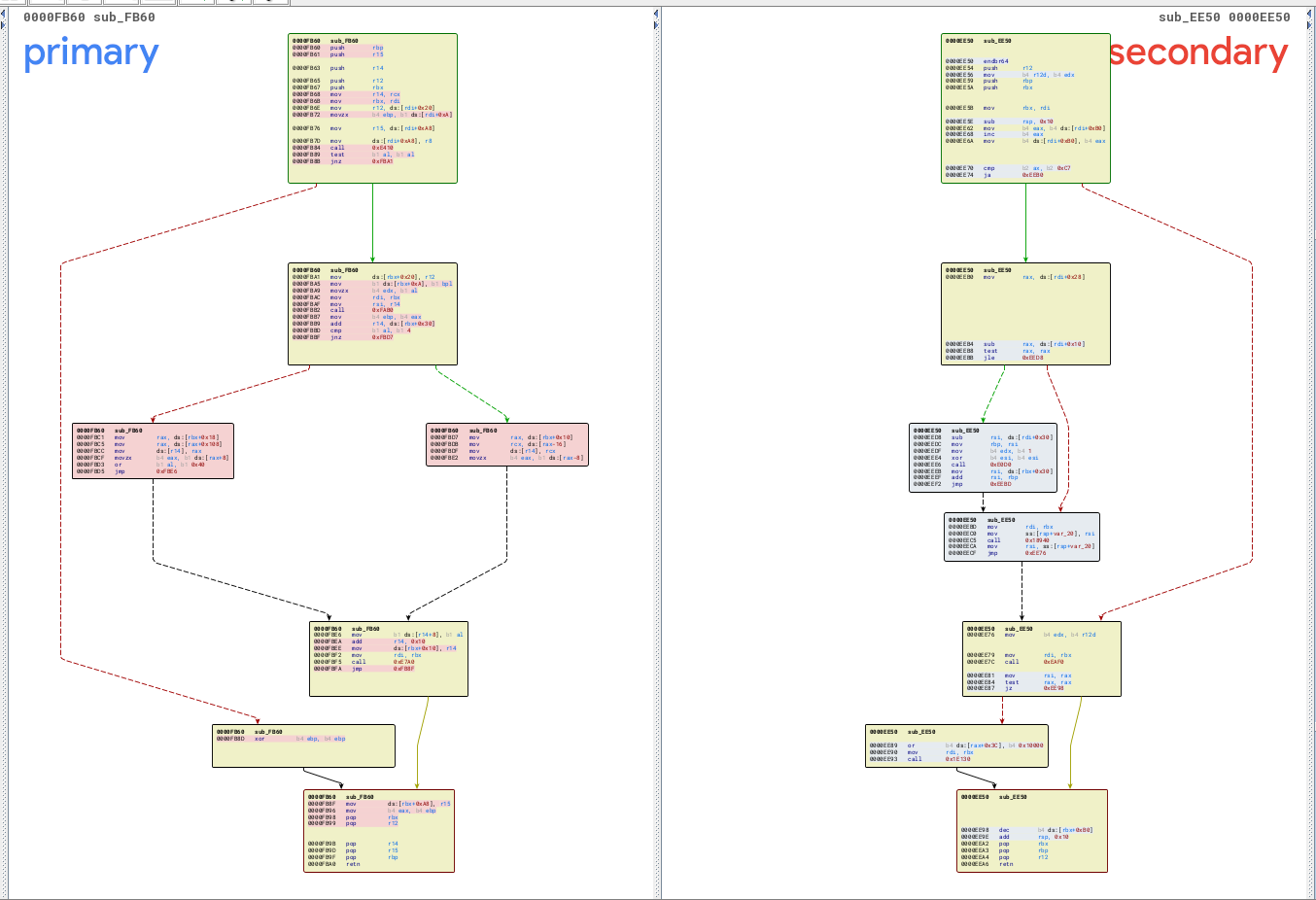
Two more graph views show the same pattern.
BinDiff matched luaD_pcall to luaD_call. DeepDiff matched luaD_pcall
correctly at 0xfb60 -> 0xf2f0.
BinDiff also matched luaG_errormsg to luaG_addinfo. DeepDiff found the
correct luaG_errormsg match at 0xd680 -> 0xd460.
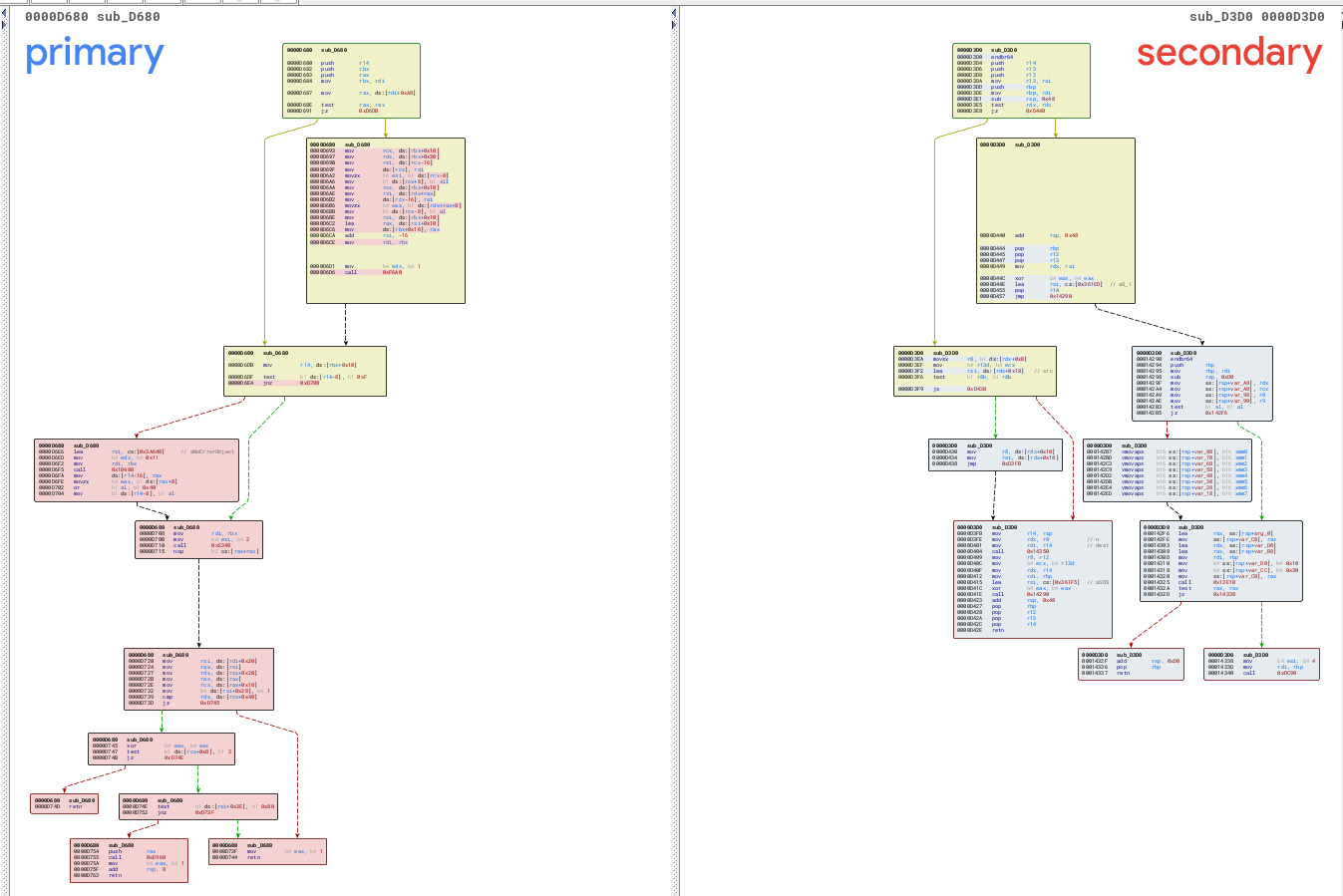
BinDiff labels stripped functions with names such as sub_XXXX. The function
names above come from the symbol-based ground truth used only for checking the
results.
Finding 2: You Cannot Match a Function You Never Found
The Lua test was mainly about matching quality. The minigzip test exposed a different problem: function coverage.
BinDiff works from functions identified by IDA. In a stripped, statically linked binary, IDA may not identify every library function. This is common for linked functions that the main program does not call.
For minigzip64-1.2.11:
- The original binary with symbols had 133 function symbols.
- Versions 1.2.11 and 1.2.12 had 130 functions in common.
- IDA identified 138 function nodes in the stripped binary.
- Only 76 of the 130 expected functions were present in IDA's function list.
The total count of IDA functions was not the important number. IDA also found functions outside our symbol-based ground truth. The key result was that 54 of the expected functions were missing from the input given to BinDiff.
For minigzip64-1.2.11 -> minigzip64-1.2.12, the results were:
BinDiff was correct for every function it matched. This is a strong result. But it found only 76 of the 130 expected matches because the other functions were not available to it.
DeepDiff found 47 of the 54 functions that BinDiff missed. Examples include:
Many of these functions were almost identical in the two zlib versions. The difficult part was not deciding whether the functions matched. The difficult part was finding the function boundaries in the first place.
gzopen is a simple example:
- The symbol table placed
gzopenat0x2200. - IDA did not create a function at
0x2200. - DeepDiff still found its match at
0x3210in the next version.
This coverage problem explains most of the recall difference in this minigzip pair. It is separate from the GCC-to-Clang result, where both tools had the functions but differed in how well they matched them.
Finding 3: The Name Can Stay While the Code Moves
Most minigzip version pairs were close. The largest change appeared in zlib 1.3.2.
In version 1.3.2, several public API functions became small tail-call wrappers.
Their main code moved into another function, often one with a *64, _z, or
_gen64 name.
The symbol sizes make the change easy to see:
This creates a problem for any result checked only by symbol name. The old symbol can still exist, but it no longer contains the old code. A useful binary match should help the analyst follow the code to its new location, even when the name changes.
For older zlib versions compared with 1.3.2, the results were:
For 1.3.1 -> 1.3.2, the strict symbol-name check counted 11 wrong matches for
each tool. The number was the same, but the errors were not the same kind:
Nine of DeepDiff's 11 name-based errors followed code to its new function:
gzseekin 1.3.1 matchedgzseek64in 1.3.2.deflateBoundin 1.3.1 matcheddeflateBound_zin 1.3.2.crc32_combinein 1.3.1 matchedcrc32_combine_gen64in 1.3.2.
The strict check marked these as wrong because the names differed. For an analyst, these are useful matches: they show where the code moved.
The other two DeepDiff matches were clear errors:
adler32_combine64 -> adler32_combinedeflatePending -> deflateUsed
BinDiff's wrong matches were mostly low-similarity matches between unrelated functions:
The zlib 1.3.2 case shows why binary matching is more than checking whether two symbols have the same name. Sometimes the most useful result is the function with a different name but the same code.
What This Means for Binary Analysis
The benchmark shows where DeepDiff's matching layer is most useful.
When the compiler changes, DeepDiff can still match functions even when their control-flow graphs have very different sizes and shapes.
When a stripped static binary contains functions that IDA did not identify, DeepDiff can find many of those function boundaries and include them in the comparison.
When an update moves a function's main code behind a wrapper, DeepDiff can follow that code to a new symbol instead of stopping at the old name.
Release-to-release comparison is one use of this alignment, but it does not define the product. The same matching layer can support any analysis that needs to connect related code across two binaries. The analyst's question decides how those matches are used.
What This Test Does Not Show
There are a few limits worth stating clearly.
- This is not a test of every binary type. The test set contains Lua and minigzip binaries. Other programs, compilers, platforms, and forms of obfuscation may produce different results.
- The symbol check is strict. It treats different symbol names as a wrong match, even when code moved and the result is useful. We reviewed those cases separately instead of changing the scoring rule after the test.
- The minigzip gap includes function coverage. Much of DeepDiff's recall gain came from finding functions that were missing from IDA's function list. This is different from the cross-compiler Lua result, which tested matching quality.
- BinDiff is strong when its input is complete and the binaries are close. It reached 1.000 precision on the detected functions in unchanged zlib pairs. Our result is not that BinDiff performs poorly in every setting.
The narrower result is more useful:
In these tests, DeepDiff was more reliable when the binaries were built with different compilers, when stripped static code was missing from IDA's function list, and when an update moved code between functions.
These cases are common in real binary analysis. The results give measured evidence for DeepDiff's core purpose: finding related code across binaries even when compiler choices, missing function boundaries, or code movement make the match difficult.
Found this useful? Share it.